
Japan's internal migration patterns under national depopulation are more complex than the government understands
Authorities should appreciate the nuances and complexities of the real experiences of internal migrants, and incorporate them into their financial incentive programmes for those wishing to resettle.

Us academics regularly have to report to our employers and funders how our research is being used. It makes sense because, with that information we can demonstrate value for time and money. But it involves sometimes laboriously trawling the internet for evidence of so-called “impact”, which UK Research and Innovation helpfully define as “the demonstrable contribution that excellent research makes to society and the economy.” There’s a bit more detail within that definition, but you can click on the link to find that out if you like.
Evidence of impact is sometimes very hard to come by, but find it I must, as my employer thinks I am making an impact, and they want to know where, who with, how, and how much. In my searches for these tiny nuggets of evidence I sometimes come across little snippets where the context is way more interesting than the fact my research has been useful. Here’s one of them that I found today, from a popular online news aggregator in Japan called BIGLOBE News.
It’s an edited excerpt from a book by Japanese researcher ITO Masato, who uses real data to examine the effects of government financial support for Japanese people to move away from Japan’s big cities and into depopulating rural areas. The intention being to try to maintain the socio-economic sustainability of these often remote places. Japan is not the only country that does this, as I show in my short article on the Japanese government’s measure to pay 1 million yen (around £5,000) to families willing to make the jump. Various incentives to move into these places exist in Italy, Spain, Ireland, and elsewhere too. But what does Ito find out about the effects in Japan?
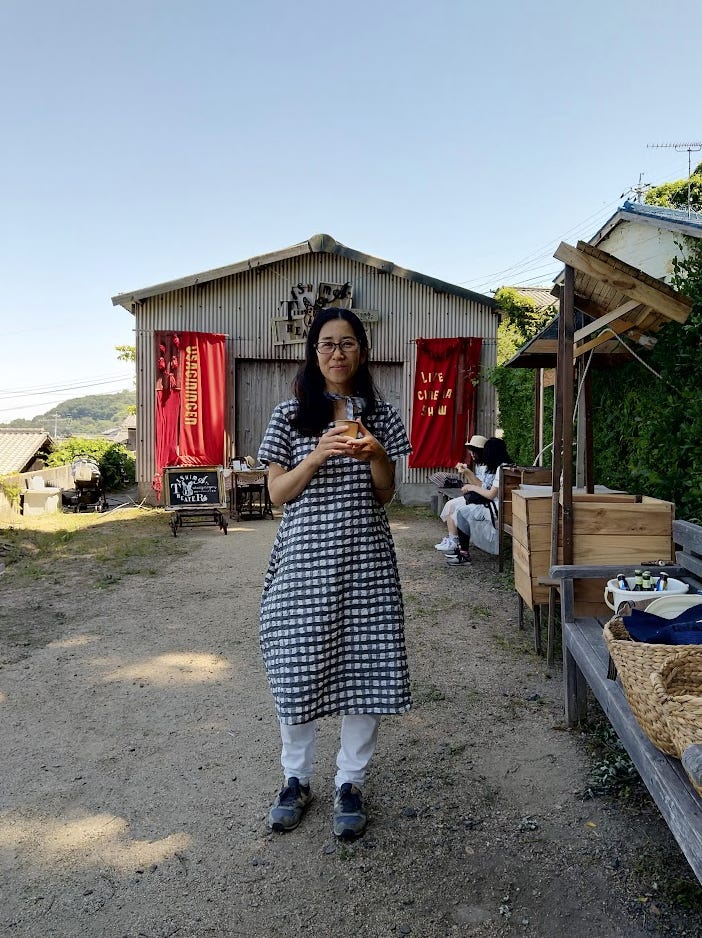
Above: A migrant who benefitted from subsidies and settled on a small island in Japan’s Inland Sea, and is now raising a family. Reproduced with permission. Image: Peter Matanle.
I translated the article from BIGLOBE News using AI tool ChatGPT, and the full text of that can be found below the line.
Here goes.
Apparently, around a third of Tokyo residents would like to move out into the countryside. That would be a LOT of people - around 12 million - if we take the whole Kanto Plain urban region. Various financial incentives from local and central governments are available for people to use to move, and Ito details a lot of them, but it seems that few people act on their apparent wish to live in the countryside. Why?
There are wide disparaties between municipalities in the amounts they receive from subsidies, and in their abilities to tap into them, which leads to inequalities and fierce competition for the funds. Inevitably, many struggle to keep up, and end up falling even further behind.
The subsidy programmes are mostly temporary in nature, and successful municipalities and migrants can often find themselves experiencing volatile financial circumstances as they receive a lot one year, and nothing the next. This outcome, of course, is counter to the desired effect of creating stable, sustainable communities.
Relocation decisions are usually based on much more than financial expediency. Other factors that come into play are employment, children, health, education, transport, and social networks and connections. Trying to persuade people to move just with financial incentives is unlikely to have a long term impact, and may even make the situation worse, as many who move might subsequently feel compelled to return to urban living.
Municipalities and prefectures might try to learn from the big cities, which do have sustainable populations that are not dependent on financial subsidies. In this way, relatively cheap, simple and straightforward policies would probably work better, with these being improving and renovating already existing infrastructure, providing basic healthcare and education facilities, and fostering friendly welcoming communities where incomers can quickly make friends and develop interdependent relationships.
As I said, Japan is not the only country to offer these kinds of relocation incentives, and its experience might be useful for other countries thinking of setting up similar programmes for migrants. And, just as Japan’s experience can inform others, so perhaps Japan can learn from them.
Finally, Ito proposes an interesting idea, that the narrative created by an apparent return to the countryside boom is itself a part of that boom, but the people who decide to make that leap find themselves facing a reality that is far more complex than the narrative of an idyllic country life foretells. This leads to contradictions, gaps and mistakes at all levels, and disappointment for migrant settlers and their families. One of these is that simplistic and linear approaches to migration are not a reflection of the real experiences of migrants themselves, and the government should perhaps do more to understand the complexities of internal migration experiences and include more flexible, adaptable and sustainable programmes to support those wanting to make the move.
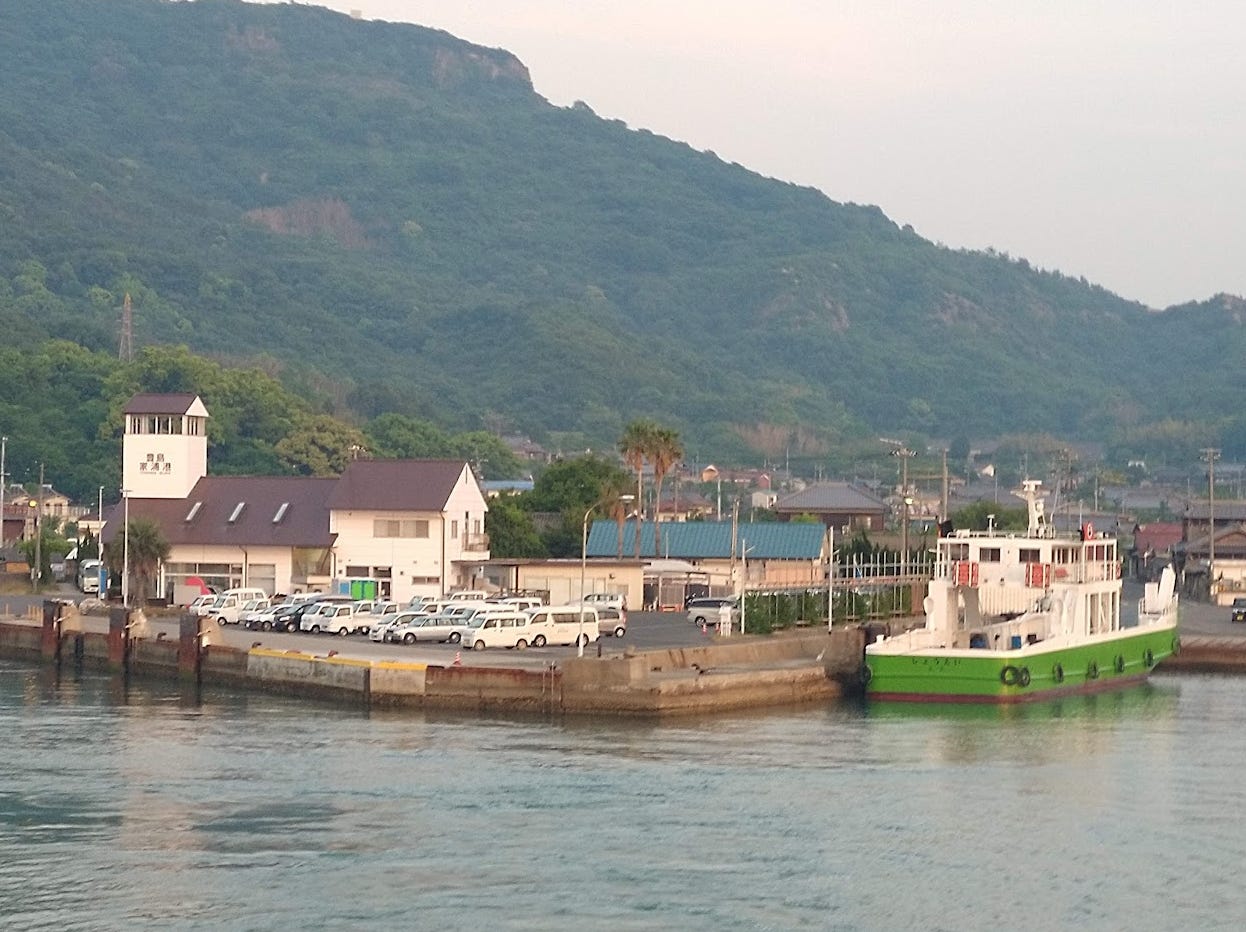
Above: A small sleepy rural town with ferry port somewhere in Japan’s Inland Sea. Image: Peter Matanle.
Researchers have been saying these things for years. Susanne Klien writes with great empathy for the subtle 21st century complexities of young migrants who live a sort of rur-urban existence in Japan’s mental and spatial places in between. This makes a lot of sense, and I see tons of evidence for that all over Japan and the UK when I get out and about observing people living in the various spaces that we call rural and urban, but that are neither, and both, all at once.
It is obvious to me that not every community can be sustainable in a country which is decreasing in size by nearly a million people per year. The maths don’t lie, as Ito is careful to stress. It’s equivalent to a city the size of Hiroshima or Manchester disappearing annually for decades into the future. It’s not possible to endure that and have every municipality maintain itself indefinitely. Some are going to disappear, whether we like it or not.
What is the Japanese government to do about this? What do the Japanese people do, in such circumstances? Maybe the answer is not to DO much at all, but just to LET life unfold. What do you think?
BIGLOBE News
"500,000 Yen for Moving!": The Disappointing Reality Behind Bold Financial Incentives for Relocation
A Long-Term Look at the Impact of Monetary Support on Population Trends
January 28, 2025, 12:30 PM – Fujin Koron.jp
According to the 6th Survey on Changes in Lifestyles and Attitudes under the Influence of COVID-19, published by the Cabinet Office in 2023, 35.1% of residents in the Tokyo metropolitan area expressed interest in relocating to rural areas. However, Masato Ito, a researcher and lecturer at the International University of Japan’s Global Communication Center, notes that the narrative of a "rural migration boom" may itself be constructing the perception of such a boom. In this article, we present an excerpt from Ito’s book, Deciphering Rural Migration Promotion Through Numbers and Facts.
The Temporary Nature of Financial Incentives for Relocation - The Prominence of Bold Financial Incentives
In recent years, various local governments have implemented policies aimed at promoting migration, one of the most notable being Miyakonojo City’s offer of a 5 million yen relocation subsidy to anyone moving from anywhere in Japan (See Figure 1).
Thanks to this initiative, the number of new residents in Miyakonojo, which had been in the hundreds per year, surged to approximately 3,700 in 2023, marking the first population increase in 13 years. This achievement gained widespread media attention as a model case of successful relocation promotion.
One of the key reasons this initiative attracted so much attention was its funding source—Miyakonojo’s record-breaking revenue from the Furusato Nozei (hometown tax donation) system (Note 1). This case illustrated how municipalities that successfully leveraged financial incentives could further strengthen their position in the competitive landscape of regional development.
However, this also highlighted a stark reality: in an environment where local governments compete fiercely over Furusato Nozei revenue, childcare support, and relocation incentives, many struggling municipalities face increasing difficulty in keeping up. This growing disparity raises concerns about whether such an approach is truly fair and sustainable in the long run.
Note 1: Minami-Nihon Shimbun, "Even the Mayor Was Surprised… Population Growth for the First Time in 13 Years Thanks to an 8.5x Increase in New Residents", April 26, 2024. Source
The History of Large-Scale Financial Incentives for Relocation
Financial incentives for relocation are not a recent development. During the 1990s, after Japan’s bubble economy burst, some relatively affluent local governments sought to differentiate themselves under the framework of decentralization. This led to the emergence of bold financial support policies as a way to attract residents and create unique regional identities.
A notable example was Mikazuki Town in Hyogo Prefecture, which in 1991 introduced a relocation incentive program based on a youth residency ordinance.
Eligible individuals (aged 36 or younger) received the following financial support:
80,000 yen for relocating and residing in the town for at least five years.
An additional 80,000 yen upon marriage.
80,000 yen for each of the first two children, with 300,000 yen for a third child and 400,000 yen for a fourth.
If working exclusively in agriculture or forestry, 1 million yen per year for three years.
500,000 yen for research travel related to agriculture or forestry.
500,000 yen for building or purchasing a home.
This comprehensive support package totaled 4 million yen (Note 2).
Note 2: Weekly Yomiuri, April 14, 1991.
Financial Incentives for Relocation: A Global Phenomenon
Japan is not the only country experimenting with financial relocation incentives. Various municipalities in Ireland, Italy, and Spain have introduced grant programs for people willing to move into depopulated towns or purchase vacant homes (Note 3).
Note 3: Peter Matanle, "Japan is Paying Families 1 Million Yen to Move to the Countryside – But It Won’t Make Tokyo Any Smaller", 2023. Source
The Limited Long-Term Impact of Financial Incentives
While municipalities have implemented bold financial incentives for decades, very few have sustained them over the long term. Although such policies often lead to a temporary surge in new residents and significant media coverage, they have rarely resulted in long-term positive effects on population trends.
This is because relocation decisions are based on more than just financial incentives. Other key factors include:
Employment opportunities
Childcare and education options
Medical facilities
Climate conditions
Transportation access
Social connections and community relations
Moreover, Tokyo, Osaka, Yokohama, Sapporo, and Fukuoka—Japan’s most attractive cities for new residents—do not offer significant financial incentives. Their appeal stems from other, more fundamental factors.
Toward Sustainable Relocation Policies
Financial incentives alone cannot drive sustainable population growth. Instead, excessive competition among municipalities may lead to financial exhaustion and counterproductive rivalries rather than long-term benefits.
If municipalities focus solely on their own short-term survival, they risk neglecting broader regional cooperation. This could ultimately hinder the development of relocation policies that genuinely benefit newcomers.
To ensure sustainable population strategies, municipalities should use financial incentives only as supplementary measures. Greater emphasis should be placed on non-monetary support, such as:
Improving local infrastructure
Enhancing childcare and education systems
Fostering welcoming communities
These efforts will be crucial in creating long-term, sustainable incentives for people to relocate—not just for financial gain, but for a genuinely improved quality of life.
This article is an edited excerpt from Masato Ito’s book, Deciphering Rural Migration Promotion Through Numbers and Facts (Gakugei Publishing).